Category Proportions = Foundation Financial Soundness (44%) + Foundation-University Sustainability (33%) + Governance (23%)
| Evaluation Area | Detailed Evaluation Indicator | Weight | Details of Evaluation Criteria |
|---|---|---|---|
| Foundation Financial Soundness (44%) |
Financial Soundness Based on Budget & Settlement | 7% | Evaluation of budget/settlement (capital) scale per student and operating profit margin |
| Statutory Contribution Payment Rate | 10% | Score of the corporation's payment rate for the university's 4 major statutory contributions | |
| Basic Income-Generating Property Ratio & Return Rate | 8% | Secured ratio and rate of return on basic income-generating assets held by the corporation | |
| Corporation Share of University Operating Expenses | 4% | Score of corporate contribution to university operating expenses relative to corporate revenue | |
| Corporate Transfer Funds (Pure Educational Support) Ratio | 7% | Evaluation of educational financial accountability based on corporate transfers per student | |
| Debt Ratio | 5% | Total debt ratio of the corporation and university (evaluated relative to reserve funds) | |
| Status of Corporate Reserve Funds | 3% | Total amount and details of reserve funds held by the corporation | |
| Foundation-University Sustainability (33%) |
INUE University Evaluation Total Score & Ranking | 10% | Core requirements for corporate sustainability linked with university evaluation results |
| University Tuition Revenue Dependence Ratio | 7% | Tuition dependency on budget/settlement (ratio of non-tuition revenue budget) | |
| University Personnel Expense Budget Ratio | 5% | Personnel expense ratio in budget/settlement (evaluation of direct expenditure on education/research) | |
| Current Term Donation Status of Corporation & University | 3% | Evaluation of total donations (general, designated, research) per student during the period | |
| Financial & Innovation Capacity of Industry-Academic Cooperation Foundation | 5% | Revenue scale and operating profit margin of the industry-academic cooperation foundation per faculty member | |
| Status of University Reserve Funds | 3% | Reserve funds and breakdown held by the university per student | |
| Governance (23%) |
Corporate Board of Trustees Composition & Operation | 10% | Appropriateness and rationality of board composition and decision-making processes |
| Corporate Committees / Subsidiaries Operation | 3% | Structure and operational evaluation of corporate committees and subsidiaries | |
| Rationality of Corporate HR Management for University | 3% | Corporate personnel management score for faculty and staff appointments, assignments, and promotions | |
| Presidential Election Method & Term of Office | 7% | Evaluation of the corporation's presidential election process, term of office, etc. | |
| Total | 100% | Fair evaluation management by Corporation Evaluation Committee |
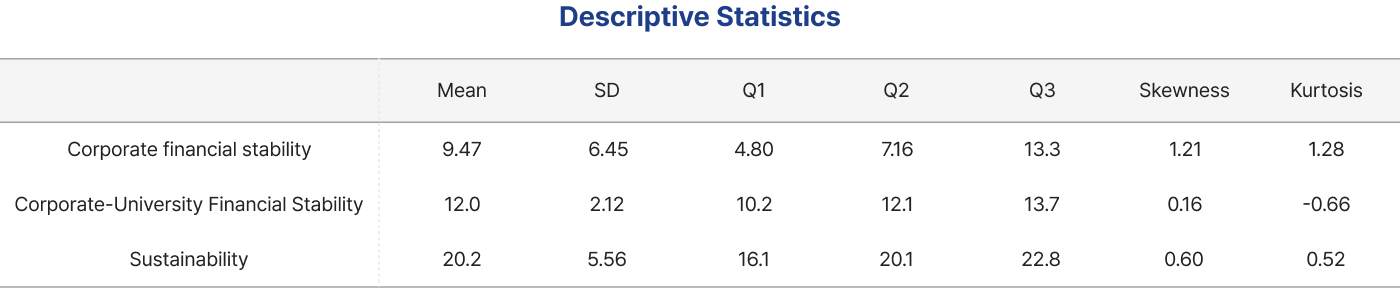
After collecting big data, six criteria are applied for verification: completeness (whether any information is missing), consistency (absence of contradictions), accuracy (alignment with actual figures), uniqueness (no duplication), validity (meaningfulness of the data), and timeliness (use of up-to-date data). In addition, to check for outliers that are excessively large or small, statistical measures such as the interquartile range (IQR), Z-scores, skewness (distribution asymmetry), and kurtosis (distribution peakedness) are used to further verify data reliability. Using Cronbach’s α and McDonald’s ω, the consistency and reliability of the detailed indicators are validated. All three domains—Financial Soundness / Sustainability / Governance—adequately reflect their original evaluation purposes and enable the derivation of highly reliable evaluation results.